Childhood myopia treatment in 2026 is receiving renewed attention after a major policy development involving the American Medical Association. In September 2026, the American Academy of Ophthalmology announced that the AMA had adopted a resolution supporting the formal classification of nearsightedness as a disease. The policy also supports better access to treatments that can slow myopia progression in children.
For parents, this development raises an important question: could childhood myopia treatment become more affordable through health insurance? The answer is promising but not immediate. A professional medical policy does not automatically require insurers to cover specific treatments or change existing insurance benefits.
Myopia, commonly called nearsightedness, causes distant objects to appear blurry while nearby objects may remain clear. It often develops during childhood and can progress as the eyes grow. Stronger prescriptions are not simply an inconvenience because higher levels of myopia are associated with increased risks of certain eye conditions later in life.
Modern eye care increasingly focuses on slowing progression rather than only updating eyeglass prescriptions. This guide explains the 2026 policy announcement, available treatment approaches, insurance considerations, and practical steps parents can take to protect their children’s vision.
Why Childhood Myopia Treatment Is Getting Attention in 2026
Traditional treatment for nearsightedness focuses on correcting blurry distance vision. Standard eyeglasses and contact lenses help children see clearly in school, during sports, and throughout daily activities. However, ordinary vision correction does not necessarily slow the underlying progression of myopia.
Myopia often develops when the eye grows too long relative to its optical focusing power. Light then focuses in front of the retina instead of directly on it. This produces the familiar difficulty seeing distant objects.
When myopia progresses substantially, the risk of future complications can increase. These may include myopic macular degeneration, retinal detachment, glaucoma, and certain other vision-threatening conditions.
These complications do not occur in every nearsighted person. Nevertheless, the long-term risk is one reason eye-care professionals increasingly recommend monitoring the rate of progression during childhood.
What the American Medical Association’s 2026 policy means
The September 2026 announcement highlighted the AMA’s support for recognizing myopia as a disease and improving access to evidence-based treatment. The resolution encourages greater awareness, childhood screening, and consideration of insurance coverage for interventions that can slow progression.
The policy reflects a shift in how childhood nearsightedness is discussed. Instead of treating myopia solely as a condition corrected with glasses, medical organizations are emphasizing its potential long-term consequences.
However, the distinction between a policy recommendation and a binding insurance requirement is essential. The AMA cannot independently require every insurer to pay for myopia management. Coverage decisions still depend on insurance contracts, regulations, medical necessity criteria, and individual benefit programs.
Parents should therefore view the announcement as an important advocacy development rather than confirmation that treatment is now universally covered.
Why classification as a disease matters for future coverage
Medical classification can influence how healthcare systems recognize conditions, evaluate treatment needs, and develop reimbursement policies. When a condition is considered more than a routine refractive error, policymakers may place additional attention on preventive treatment.
Many families currently encounter a distinction between routine vision benefits and medical insurance. Vision plans commonly help pay for eye examinations, eyeglasses, and contact lenses, while medical insurance generally follows different coverage rules.
Myopia-control treatments may fall into complicated coverage categories. Some plans exclude particular products, while others require documentation or prior authorization.
Formal recognition alone does not guarantee coverage. Actual reimbursement depends on the insurer and the specific treatment being considered.
Why stronger prescriptions are not the only concern
A child’s eyeglass prescription may change frequently during school years. Parents sometimes assume that purchasing stronger glasses is the only necessary response.
Although accurate glasses remain essential, repeated increases in myopia can justify discussing active management with an eye-care professional. The goal is to understand how quickly the condition is progressing and whether an intervention may reduce future progression.
Children with rapidly changing prescriptions may benefit from more detailed measurements and follow-up examinations.
Our existing article on childhood myopia, screen time, outdoor time, and modern myopia control explains the broader risk factors and lifestyle habits associated with this condition.
Which childhood myopia treatments are available?
Several treatment approaches may help slow the progression of childhood myopia. Their suitability depends on the child’s age, prescription, eye health, progression rate, lifestyle, and ability to follow treatment instructions.
Specially designed spectacle lenses can provide clear vision while incorporating optical features intended to influence myopia progression. Certain designs have demonstrated benefits in clinical studies, but products vary in regulatory status and approved use.
Multifocal soft contact lenses designed for myopia control offer another option for eligible children. These lenses require an appropriate fitting, consistent hygiene, and regular monitoring.
Orthokeratology involves specially designed rigid lenses worn overnight to temporarily reshape the cornea. It can correct daytime vision and may slow myopia progression in some children, but it carries contact-lens-related risks, including potentially serious infection.
Low-dose atropine eye drops are another treatment being studied and used in selected settings. Evidence varies by concentration and population, and effectiveness should not be assumed for every formulation.
How doctors decide which treatment fits a child
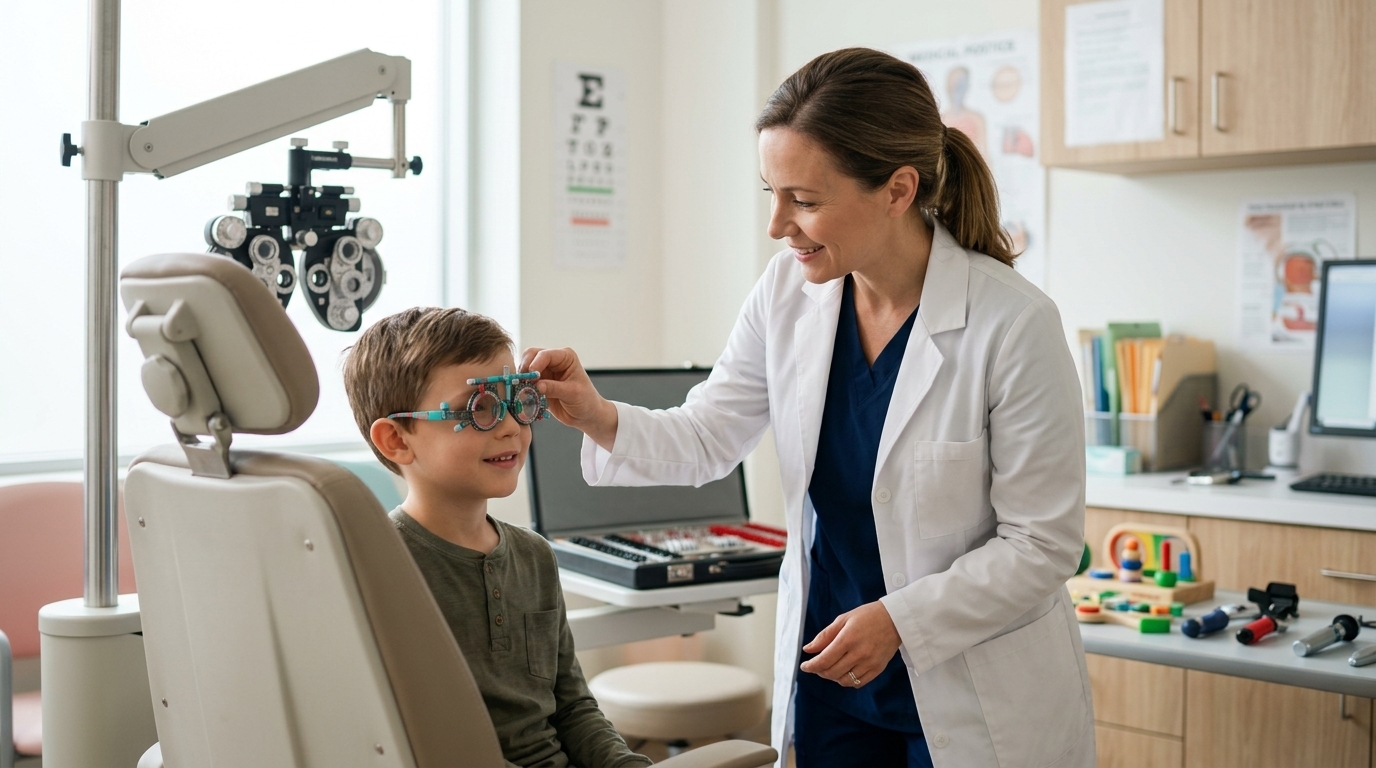
Choosing a treatment begins with a comprehensive eye examination. The clinician reviews visual acuity, refractive error, family history, previous prescription changes, and the overall health of the eyes.
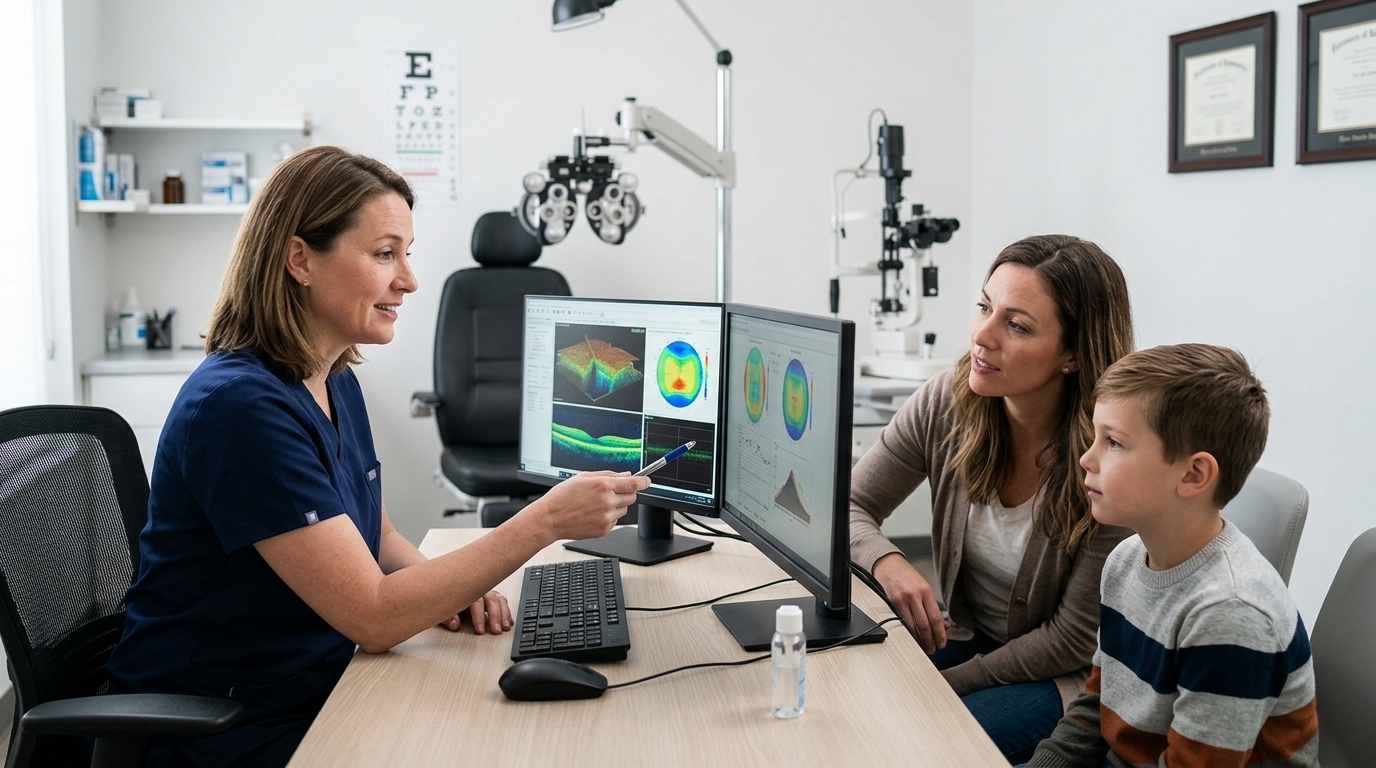
Where available and clinically appropriate, axial length measurements can help monitor eye growth. Tracking these measurements over time may provide useful information beyond changes in eyeglass prescription alone.
The clinician can then explain the expected benefits, limitations, costs, and risks associated with the available treatments.
Contact lenses require particular care because improper cleaning or sleeping practices may increase infection risk. Parents should never purchase unapproved specialty lenses or use prescription eye drops without appropriate medical supervision.
Insurance Coverage, Eye Exams, and Practical Steps for Parents
The 2026 AMA policy creates an opportunity for broader discussions about access to childhood myopia treatment. However, families should understand that healthcare coverage changes often involve additional decisions by insurers, employers, regulators, and public programs.
A treatment that is clinically recommended may still be excluded from an insurance contract. Likewise, a product approved for a particular use may not automatically qualify for reimbursement under every plan.
Parents should review both medical and vision benefits before beginning a treatment that may involve recurring costs.
It can help to ask the insurer whether examinations, specialty lenses, required follow-up visits, or prescription treatments are covered separately.
Some plans may require a referral or supporting documentation, while others may limit coverage to specific providers or treatment categories.
How parents can plan for myopia management costs
Begin by obtaining a written treatment recommendation from a qualified eye-care professional. The recommendation should identify the child’s condition, the proposed treatment, and the expected follow-up schedule.
Next, contact the insurance company and request an explanation of relevant benefits. Ask whether the treatment falls under medical coverage, vision coverage, or an excluded service.
If the insurer requires diagnostic codes, procedure codes, prior authorization, or supporting records, obtain the necessary information from the treating provider.
Parents should also request a written estimate of out-of-pocket expenses. Some approaches involve initial fitting costs, replacement lenses, repeated examinations, or ongoing medication expenses.
Understanding these obligations makes it easier to compare options without assuming that the least expensive initial treatment will necessarily have the lowest long-term cost.
Questions to ask before starting treatment

Parents should understand how rapidly the child’s myopia is progressing, what improvement the proposed treatment is expected to achieve, and how the clinician will monitor the outcome.
It is also important to ask about possible adverse effects, treatment duration, missed appointments, and what happens if the child cannot tolerate the chosen method.
For contact lenses, families should discuss cleaning requirements, infection prevention, and when to stop wearing lenses because of redness, pain, discharge, or light sensitivity.
Any significant eye pain, sudden vision loss, flashes accompanied by new floaters, or a shadow across vision requires prompt medical assessment.
For further reading on modern eye-care tools, see our article about AI and tele-optometry in eye examinations. Digital tools may support aspects of screening and monitoring, although they do not replace every component of an in-person pediatric examination.
Families considering contact lenses should also understand the importance of proper fitting, replacement schedules, and hygiene. Our guide to specialty scleral lenses in 2026 provides additional information about specialty lens care, although scleral lenses are not a standard myopia-control treatment.
Daily habits remain important even when a child receives medical treatment. Regular outdoor activity is associated with a lower risk of developing myopia, although its ability to slow progression after myopia develops is less certain.
Children should also be encouraged to take breaks from prolonged near work, use comfortable lighting, and maintain appropriate reading distances.
These habits support visual comfort and healthy routines, but they should not be presented as guaranteed alternatives to clinically indicated treatment.
official September
Parents should avoid blaming a child for developing nearsightedness. Genetics, environmental exposure, and other factors can influence the condition.
For the official September 2026 policy announcement, consult the American Academy of Ophthalmology’s report on the AMA myopia resolution.
The announcement demonstrates growing professional support for early identification and access to treatment. It does not establish an immediate nationwide insurance mandate.
Routine monitoring can help families make better decisions. A child whose prescription is stable may need a different management approach from one whose myopia progresses rapidly.
Follow-up visits also allow the clinician to assess treatment tolerance, visual development, and whether adjustments are appropriate.
Parents should keep copies of prescriptions and examination results. A clear record of changes over time can support both medical discussions and insurance inquiries.
Children who experience blurry distance vision, frequent squinting, headaches, or difficulty seeing classroom materials should receive an appropriate eye evaluation rather than waiting for the next routine visit.
Childhood myopia treatment in 2026 represents an evolving area of preventive eye care. New professional policies may eventually improve access, but treatment decisions still require individualized assessment and realistic expectations about insurance coverage.
The most useful approach is to understand the child’s progression, review evidence-based options, confirm financial responsibilities, and maintain appropriate follow-up care.
Medical Disclaimer: This article is for educational purposes only and does not replace individualized medical advice. Treatment availability, regulatory approvals, and insurance coverage vary. Consult a qualified eye-care professional for diagnosis and treatment recommendations.